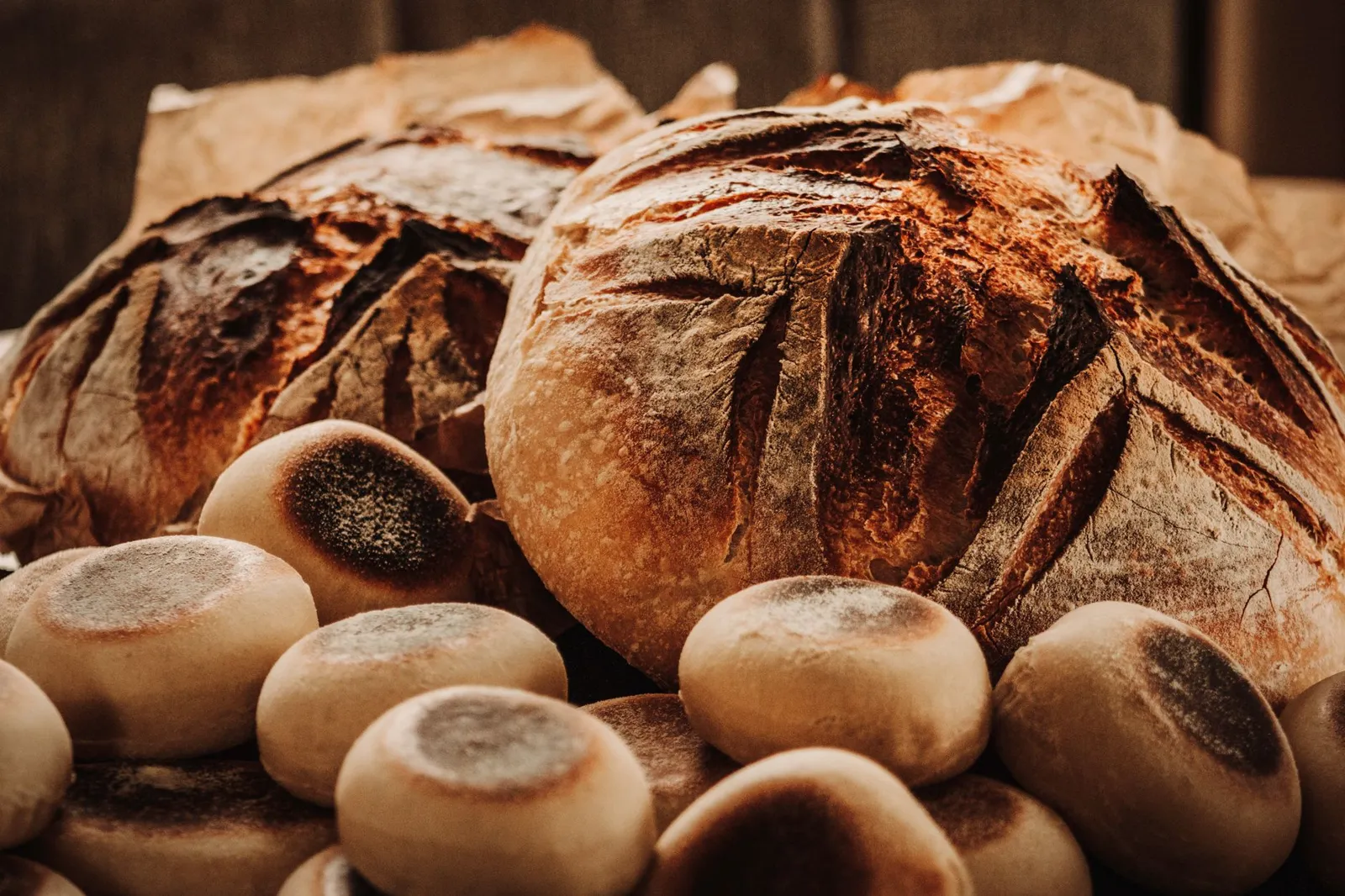
People often ask why a loaf costs HK$68 when a supermarket version costs a fraction of that. The honest answer is not about expensive flour or a secret ingredient. It is that most of what we sell is time: two days of it, in a warm room and a cold room, attended by someone who could be doing something else.
It starts the night before
At nine o'clock in the evening, whoever closes the shop feeds Winnie, our rye starter. She gets a small amount of her old self, fresh flour and water in a one-to-five-to-five ratio, and is left at room temperature overnight. In summer she sits in the coolest corner of the kitchen; in winter she gets the shelf above the oven.
By morning she is domed, bubbly and smells faintly of yoghurt and green apple. If she smells sharp or has collapsed, she does not go into the bread. A starter is a living thing, and a tired one makes a tired loaf. This is the first place where a shortcut would show.
The dough is never in a hurry
Mixing begins around six. Flour and water rest together for forty-five minutes before the starter and salt join — a short autolyse that lets the flour hydrate and makes a gentler dough. Then the folding starts: a set every thirty minutes for about two and a half hours, each one a few turns by hand.
The bulk ferment takes four to five hours in total. We look for a rise of roughly thirty to forty per cent, a domed surface and a few bubbles at the edge of the bowl. The clock is a guide, not an instruction. On a humid November morning the dough moves faster than it does in January.
A long, cold night
Once the dough is ready, it is divided, pre-shaped and left to relax. Then it is shaped into its final form and goes into a linen-lined basket in the cold room at 4°C. It stays there for eighteen to twenty-four hours.
This slow, cold prove is where much of the flavour develops. The yeast works slowly, the acids build gently, and the dough becomes easier to score and more forgiving in the oven. It also means we can bake at five in the morning and still have warm bread at half past eight.
Sourdough is less a recipe than a schedule with feelings.
Baked on stone, rested before slicing
The stone-deck oven is switched on at 3:15 and takes a full hour to reach temperature. Each loaf is turned out of its basket, scored with a blade and loaded with steam. A country loaf bakes for around forty-five minutes, until the crust is dark and the base sounds hollow.
Then comes the part most people skip at home: the loaf rests for at least two hours before it is cut. A hot loaf is still setting inside. Slice it too early and the crumb turns gummy, even though the bread itself is perfectly baked.
What this means for you
Because the process is long and the batches are small, we bake to a number rather than to a shelf. When the bread is gone, it is gone until the next bake. That is not scarcity marketing; it is simply what one oven and six bakers can do properly.
At home, keep a loaf cut-side down on a board for two days, or in paper rather than plastic. For longer storage, slice it and freeze it; it toasts beautifully from frozen. A loaf bought on Saturday will still be good on Wednesday, which is not something you can say about most bread.
A note on allergens: our kitchen handles wheat, rye, barley, dairy, eggs, nuts and sesame. If you have a specific dietary requirement, please speak to the team before ordering.